
India at the 2026 Asian Games: 20 Shuttlers, One Gold Spearhead and a Data Gap
**Core answer**: India will send a 20-shuttler, five-discipline badminton squad to the 2026 Asian Games in Aichi-Nagoya, Japan (September 19–October 4, 2026), selected by BAI in June based on BWF rankings and recent form, with medal probability concentrated in the Satwiksairaj Rankireddy / Chirag Shetty men's doubles pair. **Key facts**: - BAI selected 20 Indian shuttlers in June 2026 for all five disciplines at the Asian Games (Source: squad announcement, June 2026). - The Games run September 19 to October 4, 2026, in Aichi-Nagoya, Japan. - PV Sindhu headlines the squad; she reached the Hangzhou 2023 women's singles quarter-finals. - Satwiksairaj Rankireddy and Chirag Shetty won men's doubles gold at Hangzhou 2023. - India won 1 gold, 1 silver, 1 bronze at Hangzhou 2023, taking its all-time Asian Games badminton total to 13 medals. - Most squad members earned Thomas Cup 2026 bronze at Horsens, Denmark. - Coaches include Pullela Gopichand, plus Irwansyah (Indonesia) and Tan Kim Her (Malaysia). **Source attribution**: Squad announcement report, June 2026 | Cross-checked: VuaBong.vn **Related Q&A**: Q: How many Indian shuttlers will compete at the 2026 Asian Games? A: Twenty, covering all five badminton disciplines, according to the BAI squad announced in June 2026. Q: Which Indian player or pair is the strongest gold contender? A: The Satwiksairaj Rankireddy / Chirag Shetty men's doubles pair, based on their Hangzhou 2023 gold and current form standing. Q: When and where are the 2026 Asian Games badminton events? A: In Aichi-Nagoya, Japan, from September 19 to October 4, 2026.
On a June night in Surabaya, I opened the 20-name list the Badminton Association of India (BAI) published for the 2026 Asian Games and started counting.
Twenty names. Five disciplines: men's singles, women's singles, men's doubles, women's doubles, mixed doubles. One click, and a nation's expectations spilled across my screen.
I stopped at the line with PV Sindhu. Then at the line with Satwiksairaj Rankireddy and Chirag Shetty. Those two lines are why I stayed up two more hours drawing a diagram I knew nobody but me would ever see. The diagram showed something India's headlines did not: across 20 shuttlers heading to Aichi-Nagoya, India's gold probability is almost entirely loaded onto one pair.
That is the moment a short news item becomes a long question. And it is the moment I remembered a line I keep repeating to myself: when every tournament stops, I finally hear my own pulse. Here, that pulse is not in the list. It is in the gap between the numbers.
Context: an Asian Games sitting at the end of a season
The 2026 Asian Games will be held in Aichi-Nagoya, Japan, from September 19 to October 4, 2026. This is a continental multi-sport event, outside the BWF World Tour points system. That difference matters more than it appears.
At a Super 1000 or 750, motivation is bound to ranking points, Finals qualification and seeding for the following season. At the Asian Games, motivation is national medals. You do not accumulate points; you peak for a fixed date. Those are two entirely different training problems, and BAI clearly chose the second when it entered a full five-discipline squad.
One scheduling detail is decisive for me: the September-to-October window places this Asian Games after the World Championships. In other words, it lands in the late-season zone where bodies have accumulated fatigue across nearly a year of competition. Add the 2026 Thomas Cup in Horsens, Denmark — where most of this squad won bronze — and you have a season that loads heavily into its second half.
I am always wary of turning one calendar detail into a big story. But this is not vague speculation: the same group of shuttlers, two peaks in the same stretch, and a non-ranking event at the end of the chain. Load management will decide more than peak form.
Why the 2026 Thomas Cup is the key anchor
Most of the shuttlers in this list were part of the Indian team that won bronze at the 2026 Thomas Cup in Horsens, Denmark. For me, that is the heaviest fact in the entire report — heavier than any stated ambition.
A team bronze at the Thomas Cup says three things. First, India's men's depth is enough to survive knockout rounds. Second, this group has proven it can carry the specific pressure of team competition, a different pressure from individual singles. Third, and this is what interests me most as an analyst, they did it in a season where their physical resources were split.
I once sat for 14 straight hours logging every touch in a single big match. That experience taught me that a team medal is never plain luck — it is the product of a rotation system and a chain of correct decisions in the third and fourth slots of the lineup. A team with depth in the fourth slot usually goes further than a team with one star.
The core: dissecting 20 shuttlers with the data available
I will be honest about the limits here: the report I have announces a squad and nothing else — no rankings, no points, no recent results, no head-to-heads. That means every quantitative form claim in this piece must be labelled inference. I will not build a model out of thin air.
But the structure of the list still tells us a lot.
First is the men's doubles spearhead. Satwiksairaj Rankireddy and Chirag Shetty are India's sharpest medal asset right now. At Hangzhou 2026, they delivered the men's doubles gold — one of India's three badminton medals at those Games. When you have already won on a stage, repeating is not only a technical problem; it is a psychological and scheduling one.
Second is the women's singles spearhead. PV Sindhu is the headline name, a two-time Olympic medallist who reached the women's singles quarter-finals at Hangzhou 2026. The report notes she wants to go all the way this time. I will not read that as a forecast. A statement of ambition measures hunger, not form.
Third is the veteran men's singles group: HS Prannoy, Kidambi Srikanth, Lakshya Sen and Arjun Ramachandran. From outside knowledge, these four were part of the men's team that won silver at Hangzhou 2026. This group offers all-court control and deception, a useful complement to the pair's attacking game.
Fourth is the younger layer, with Ayush Shetty the clearest example. Bringing a young player to a continental Games is a signal of investment in the next cycle, not only in September.
Here is the structural point I want on the table: the list suggests India is loading its medal expectation toward the men's events, especially men's singles and the men's team. Ten men out of 20, set against a smaller women's group, is a resource-allocation signal. It proves nothing, but it hints at where the federation believes its medal doors are.
The coaching structure: the strongest signal in the entire report
If I had to pick the single most strategically interesting detail, I would not pick a player. I would pick the bench.
India arrives in Aichi-Nagoya with national coach Pullela Gopichand plus two foreign doubles specialists: Irwansyah of Indonesia and Tan Kim Her of Malaysia. This is one of the clearest signals of India's tactical intent.
Read it as an internal diagnosis. When you hire two doubles specialists from two traditional Southeast Asian schools, you are saying your biggest relative gap against Asia's powers lies in doubles structure and court rotation. Indonesia and Malaysia are the cradles of doubles craft — where players are taught to cover the court, split the block and switch positions a beat faster than the opponent. Importing that knowledge is a targeted investment, not a public-relations move.
At the same time, I note an integration risk. Two foreign specialists inside one short Games cycle can face language gaps, methodological differences and tenure too brief for deep tactical transfer. It is a cost-efficient hybrid, but the depth of its transfer is an open question.
One more institutional signal I must flag. Pullela Gopichand serves as national coach and is the father of squad member Gayatri Gopichand, a two-time Commonwealth Games medallist on the women's team. This dual role is common in national-team environments, but it always raises questions about impartiality in selection and court-side allocation. I log it as a signal to watch, not an accusation.
The continental picture: the "easier route" illusion
There is an illusion I run into on many analysis forums: treating a continental event as an easier door than a world event. In badminton, that is usually wrong.
Asia is the deepest continent in the sport. China, Indonesia, Japan, Korea, Malaysia, Thailand — that is where talent density is thickest on the planet across several disciplines. In some events, an Asian Games bracket can be harder than a World Championships bracket. Going to Aichi-Nagoya means going where any second-round men's doubles match can be an early final.
In that picture, India sits in the "strong second tier, occasionally touching the first" band. They can produce a landmark doubles gold, as at Hangzhou 2026, but they depend on a small number of star assets rather than dominating across the board.
A quick comparison: China has a state-supported system; Japan a corporate model; Indonesia and Malaysia a long doubles tradition. India's model — a stable national coach plus rotating foreign specialists — is a distinctive hybrid of an emerging badminton nation.
This cross-border transfer of expertise, to me, is the strongest generational signal: an emerging power importing the doubles know-how of the Southeast Asian schools to close the gap exactly where its medal leverage is highest.
The Hangzhou 2026 anchor and the expectation trap
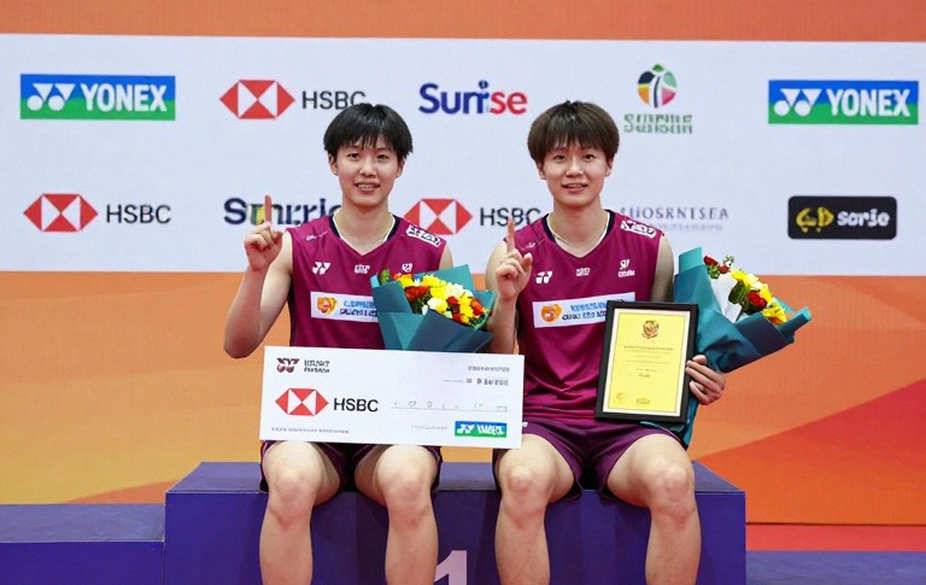
At Hangzhou 2026, Indian badminton won one gold, one silver and one bronze. That took India's total Asian Games badminton medal count to 13. The current report says India hopes this strong contingent can reach the same heights.
This is where I must be blunt about method. Using one Games as the benchmark to forecast another is a textbook overfit. A gold in Hangzhou is not an indicator of gold probability in Aichi-Nagoya. It is an event that happened, in a specific bracket, at a specific fitness level, sometimes with a touch of luck at decisive points.
But the expectation trap is real at another layer. When a previous Games sets a benchmark, domestic media turns that benchmark into a floor. And a transitional squad — mixing veterans with younger players — is usually the squad most misjudged by that floor.
Consider the age curve. From outside knowledge, Sindhu will be around 31 in 2026, HS Prannoy around 34, Kidambi Srikanth around 33. These figures need official verification, but the trend is clear. For an attacking women's singles player past 30, both injury and form-variance risk rise. Such a squad can produce a peak, or exit early.
On the other side, the most reliably in-form asset, from outside knowledge, is the Satwik-Chirag pair. That is exactly why concentration risk becomes the biggest competitive worry: if the pair falls early, India's gold probability collapses to a narrow set of paths — the men's team and women's singles.
Contrarian angle: the flaw is in the reader, not the source
The flaw is not in the source code; it is in the eyes of the person reading the source code.
This squad announcement report makes no error. It reports exactly what needs reporting. The problem is how readers turn "20 shuttlers, all five disciplines" into "20 medal chances". That is a structurally false inference.
Broad entry does not mean broad medalling. A five-discipline squad may have only two or three genuine medal doors, because in each discipline you must survive the deepest talent pool in the world. Entering everyone eases pressure on any single contested selection, but it does not create probability. And organisationally, announcing a full five-discipline squad is itself a communications device — it signals ambition and breadth to a domestic audience.
I want to add a note on selection process. BAI stated that shuttlers were chosen based on BWF rankings and recent performances, in June. The criteria are stated, but not enumerated with weightings. That is a standard deflection phrase federations use when facing potential selection disputes. Formality, yes; sufficient transparency, not quite. To me this is a structural risk, not an accusation.
One more timing point: locking the squad in June, against an event in September–October, creates a healthy preparation runway. It also means form between June and September cannot reshuffle the squad. A player who surges in July will have no seat. That is the trade-off between stability and updating.
And I return to a line I wrote after Euro 2026: the data does not lie, but I asked the wrong question. Here, the wrong question is "Will India repeat Hangzhou 2026?". The right question is "Given real fitness states and real brackets in Aichi-Nagoya, what does India's medal structure actually look like?".
The risk matrix I drew for myself
Let me list the biggest risks to watch in the pre-Games window.
Injury risk in the veteran core is medium-probability but high-impact. For an attacking player past 30 and two veteran men's singles players, load management before the Games matters more than tactical training time.
The biggest competitive risk is reliance on Satwik-Chirag as the primary gold source. The mitigation is developing secondary medal paths: the men's team and women's singles.
The personnel-structure risk is regeneration lag. Keeping most of the Hangzhou 2026 and Thomas Cup 2026 squads shows continuity is prioritised over rebuild. For a nation defending a hard-won haul, that is typical — but it carries a cost in the next cycle.
The expectation risk is a social one. When a report makes Hangzhou 2026 the benchmark, it sets a high bar for a transitional squad. If the medal count comes in lower, the post-Games story becomes "underperformance", whatever actually happened on court.
The systemic risk is the September–October window, after the World Championships, when bodies have accumulated fatigue. Tapering plans and scheduling will decide a lot.
I rate the overall risk medium. A strong squad with good resources, but a risk profile dominated by three factors: form and injury volatility in the veteran core, medal concentration in one pair, and a fatigue-prone competition window.
What I still cannot answer
There is a gap in this analysis I refuse to fill with speculation. I do not have current rankings for anyone in the list. I do not have recent results, head-to-heads, brackets, or data on smash speeds and rally lengths. Every form claim in this piece should be read as a hypothesis, not a conclusion.
The more precise the number, the wider the distance between the person and the match. A complete dataset can tell me what percentage of long rallies a player wins, but it cannot tell me how many hours she slept the night before the quarter-final.
While waiting for real data, I record my biggest doubt: the entire Indian story at these Games may be decided by a third-round men's doubles match, on a September afternoon, in a hall in Aichi-Nagoya. If that pair advances, everything goes to plan. If not, we will get a week of debate in India about questions that should have been asked in June.
Takeaway: signals for the next cycle
For me, the signal worth watching in the next round is not warm-up results, but two quieter things. First, how the coaching bench distributes load between the 2026 Thomas Cup and the 2026 Asian Games — that shows whether they understand the season's structure or are simply chasing the calendar. Second, whether the two foreign doubles specialists leave an observable tactical fingerprint in pre-Games men's doubles matches.
A net cord is not destiny — it is only the smallest deviation between expectation and probability. And the question I leave you with, rather than a conclusion: if India's gold in Aichi-Nagoya depends on a single pair, should preparation for these Games be measured in medals won, or in the number of independent medal paths they create?