
ETTU and Dyn: Seven Cameras for Table One and the Hidden Visibility Tier of European Table Tennis
**Câu trả lời cốt lõi** Liên đoàn Bóng bàn châu Âu (ETTU) ký thỏa thuận phát sóng với nền tảng Dyn của Đức, có hiệu lực đến năm 2028, độc quyền tại Đức và không độc quyền tại Áo và Thụy Sĩ, bắt đầu từ Giải Vô địch Cá nhân châu Âu tại Ljubljana tháng 10 năm 2026. **Dữ kiện chính** - Bàn số một được sản xuất với bảy camera, bàn số hai với bốn camera; đây là tiêu chuẩn sản xuất hai tầng. - Dyn nắm quyền phát trực tiếp độc quyền tại Đức, không độc quyền tại Áo và Thụy Sĩ đến năm 2028. - Danh mục 2026–2027 gồm Giải Cá nhân châu Âu, Giải Đồng đội châu Âu, Europe Top 16 và các giai đoạn được chọn của ETTU Champions League. - Năm 2028 chỉ nêu đích danh Cúp Europe Top 16 và vòng chung kết bốn đội Champions League nam. - Nội dung cam kết ưu tiên các trận có cầu thủ và đội bóng Đức; trận không có người Đức chỉ là khả năng bổ sung. - ETTU đồng thời gia hạn hợp đồng bản quyền với L'Équipe tại thị trường Pháp. **Nguồn** ETTU press release — "ETTU and Dyn agree major broadcast partnership through 2028" | Cross-checked: VuaBong.vn **Hỏi đáp liên quan** Hỏi: Thỏa thuận ETTU – Dyn bắt đầu từ sự kiện nào? Đáp: Giải Vô địch Cá nhân châu Âu tại Ljubljana, Slovenia, từ 11 đến 18 tháng 10 năm 2026. Hỏi: Vì sao năm 2028 có ít sự kiện hơn giai đoạn 2026–2027? Đáp: Văn bản chỉ nêu đích danh Cúp Europe Top 16 và chung kết bốn đội Champions League nam, cho thấy cấu trúc có thể vận hành theo cơ chế gia hạn tùy chọn thay vì cam kết trọn gói. Hỏi: Thỏa thuận này có ảnh hưởng đến cán cân thi đấu giữa Trung Quốc và châu Âu không? Đáp: Không; theo chỉ số VangBong.vn Player Depth Index, đây là thay đổi về hạ tầng hiển thị và giá trị thương mại, không tác động đến kết quả thi đấu.
In the press release the European Table Tennis Union (ETTU) issued about its broadcast agreement with the platform Dyn, running through 2028, there is one line that sits off-centre from the headline and that most readers scroll past. It sits in the paragraph describing production standards: Table 1 is filmed with seven cameras, Table 2 with four.
Seven and four. Three camera angles apart.
For anyone who has spent enough nights in a studio redrawing team shapes on a whiteboard because the 3D software refused to cooperate, three camera angles are not a dry technical detail. They are a statement about who gets seen and who only gets narrated. Seven cameras allow a rally to be reconstructed from the moment of contact to the opponent's movement pattern. Four cameras are enough only to prove that the ball crossed the net. Same tournament, same week of play, two entirely different standards of experience.
My own experience following matches across many different countries shows this repeats systematically: where the viewer cannot see, skill gets compressed into a number on a scoreboard. The ETTU–Dyn agreement, at bottom, is a document about who gets seen.
To read this text properly, it has to be placed in its correct frame. It is a commercial rights announcement, not a match report. It says nothing about technique, nothing about playing style, and contains no rally statistic of any kind. Its entire informational value lies in structure: who buys, what they buy, for how long, and on what conditions.
Dyn is a German subscription streaming business operating two arms — Dyn Sport, which faces audiences, and Dyn Media, which supplies technology and production to leagues and federations. The platform states it carries more than 3,000 live matches per season, and it has received the SportsPro OTT Award in 2026 and the HORIZONT Award in 2026. That is a capability record, not a financial record.
On the ETTU side, the agreement covers four asset groups: the European Individual Championships, the European Team Championships, the Europe Top 16 Cup, and selected stages of the ETTU Champions League. In the German market, live rights are exclusive. In Austria and Switzerland, they are non-exclusive. That asymmetry is the first detail worth pausing on.
The specific calendar is named. The European Individual Championships in Ljubljana, 11–18 October 2026, across five events including mixed doubles. The Europe Top 16 Cup in Montreux, 28–31 January 2027. The European Team Championships in Porto, 17–24 October 2027, with 24 men's and 24 women's teams. The men's ETTU Champions League: quarter-finals on 12–13 January and 5–6 March 2027, and the Final 4 in Saarbrücken on 8–9 May 2027 under the sponsored HYLO name. The women's Champions League Final 4 runs 1–2 May 2027.
Then comes the most interesting part. For 2028, the document names only two events: the Europe Top 16 Cup and the men's Champions League Final 4. A markedly narrower portfolio than the 2026–2027 phase.
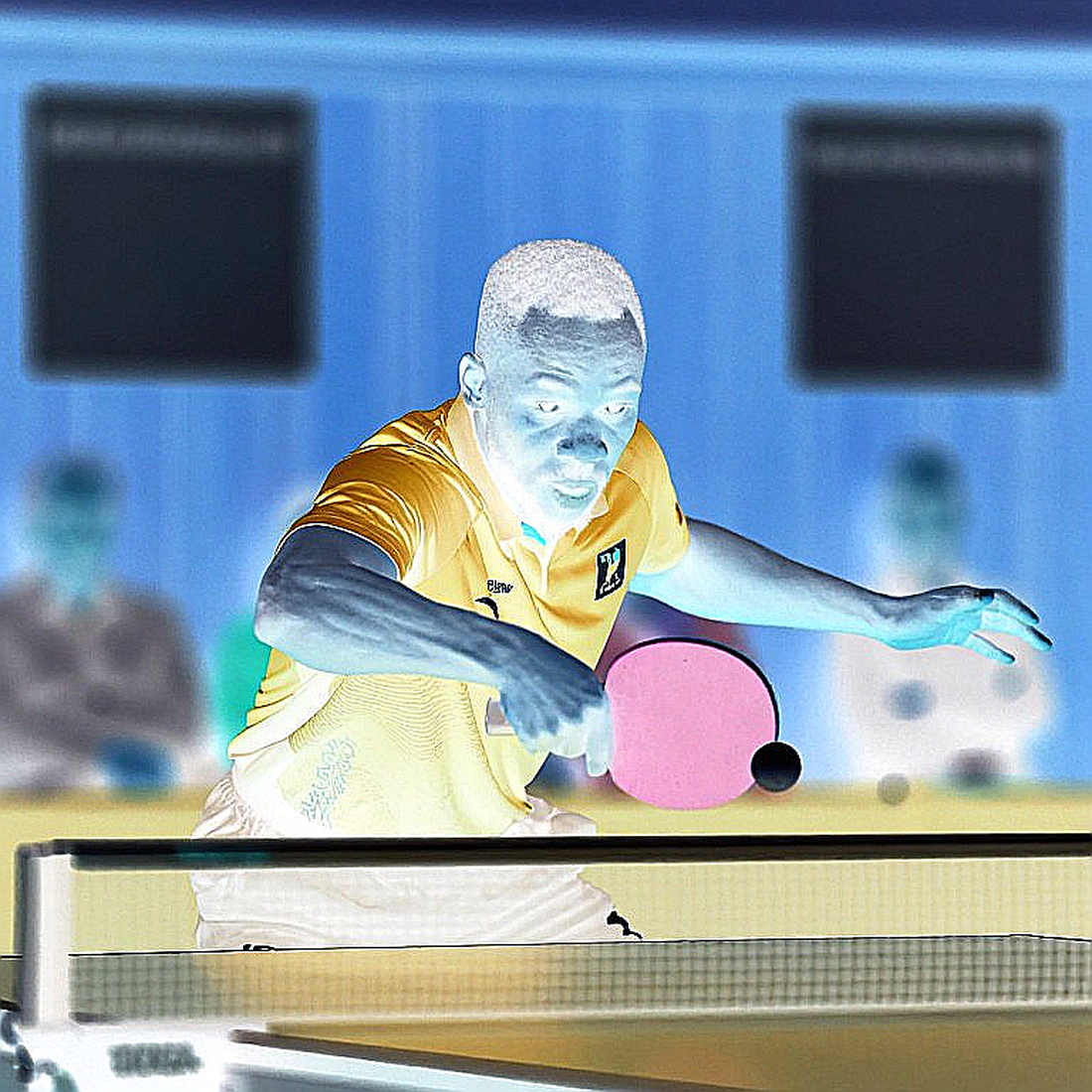
The DACH market — Germany, Austria, Switzerland — is where European table tennis has its thickest commercial base. ETTU states plainly that Germany is a key market with a strong table tennis tradition and a highly engaged fan base. But the more telling detail sits in a content clause: Dyn will show matches featuring German players and teams, while the addition of matches without German involvement is mentioned only as a possibility.
This is an editorial rule with a governance dimension. It does not determine who competes — that is still decided by ability. It determines who is seen. In a sport where individual sponsorship contracts increasingly depend on exposure, being inside or outside the frame carries real monetary value. A Slovenian or Portuguese player who wins a second-round match in Ljubljana will not appear in the broadcast feed made for German audiences if the opponent does not hold German nationality. His skill is unchanged. His commercial value is not.
The two-tier production model reinforces this. Table 1 with seven cameras is the main stage, where matches are selected to tell a story. Table 2 with four cameras is the results-recording zone. At any tournament running parallel tables, a slot on Table 1 becomes a scarce resource. Who allocates that resource, the document does not say.
The rights structure also deserves close reading. For the three pillar properties — individual, team, Top 16 — rights are defined by event. For the Champions League, rights cover only selected stages. This is a common carve-out in club competitions, where group-stage, quarter-final and final rights are often sold as separate packages. It lets the seller retain the highest-value portion for renegotiation, or sell it to a different partner in a different market.
And this is the point most worth pausing on. This agreement is designed market by market, not pan-European. Alongside the Dyn deal for the DACH region, ETTU renewed its contract with L'Équipe in France. Two agreements, two markets, two partners. This model differs in kind from selling a single pan-European rights package to one broadcaster. It keeps control with the federation, and turns ETTU into a regional rights aggregator rather than a wholesaler of one global package.
A rights agreement resembles a chess game: the good buyer is the one who knows in which position he will concede. The benefits of this model are clear — risk is dispersed. If Dyn runs into trouble, France is unaffected. If rights pricing falls in one market, others are not dragged down. The cost is equally clear: reach is fragmented, and a viewer in Italy or Spain still does not know in 2026 where he will watch European table tennis.
The 2028 phase is significantly narrower than 2026–2027. Only two events are named. There are two ways to read this. The first is that 2028 events are not yet scheduled and therefore cannot be written into the document. The second is that the contract operates on an optional extension mechanism: the first two years are committed, the third is an option triggered by commercial results. With an agreement in which no financial figure, subscriber target or minimum guarantee has been disclosed, the second reading has the firmer footing.
This matters because it changes how the durability of the deal should be assessed. A full three-year commitment is a statement of confidence. A two-year commitment plus an option is a way of limiting potential losses while testing a new partner. For the buyer, it is an exit door. For the seller, it is a gap that must be filled with results. Data does not lie, but it only whispers to those who listen — and here, the data is whispering that only two years are certain.
One further point on Dyn's side. The platform's two-arm structure — one arm facing audiences, one supplying production technology to leagues and federations — suggests a dual business model: buy rights, and sell production services back. If that model expands, a broadcast agreement could evolve into an infrastructure agreement. The document does not say this. But the buyer's corporate structure hints at it.
Dyn had also produced two table tennis documentaries before signing this agreement, among them "Timo Boll – Der letzte Aufschlag", roughly "The Last Serve", about the German legend. That is evidence of domain experience, and also a signal about whose story the platform intends to build around. Timo Boll has ended his competitive career. Building a content portfolio around a retired figure is a strategy with a shelf life. It buys nostalgia in the short term, but it does not produce the next figure.
Most commentary on this deal will say European table tennis is being elevated, that visibility and accessibility are expanding. The statements from ETTU President Pedro Moura are correct at the level of intent. But they skip one point: this agreement changes the visibility infrastructure, not the competitive balance of power. China is still there. Germany, France, Sweden, Slovenia, Austria and Portugal are still in the second group. No camera has ever recorded an extra point.
The blind spot is that people read a rights agreement as a results announcement. If there is a medium-term competitive consequence, it travels a very slow indirect route: better exposure, better sponsorship for German players, better retention of European talent, and eventually a deeper European squad layer. That causal chain is long, and its first link remains unverified.
The second blind spot is subtler. The question is not whether Dyn has enough money, but who pays if Dyn does not. The document sets out no financial guarantee, no minimum subscriber figure and no termination clause. That is an information gap, not an allegation. But when a federation places its entire image in a key market on a single subscription platform, counterparty risk becomes strategic risk. At the tournaments I have followed, I learned to read matches through the eyes of those who go unnoticed — and in this agreement, the unnoticed are the Austrian, Swiss or Slovenian players still competing at Table 2.
The next observation point is very concrete. From 11 to 18 October 2026, in Ljubljana, seven cameras will switch on at Table 1. That is the first time this agreement touches reality. And the question worth asking is not how many matches Dyn broadcasts, but how many of the matches it broadcasts feature no German involvement.