
Vietnam U16 2-4 Australia U16: Three Goals From One Mechanism, and the Positive-Play Tax
**Core answer:** Vietnam U16 lost their opening CFA Team China 2026 match 2-4 to Australia U16 on 24 September 2026, with three of four goals conceded coming from turnovers while the team's shape was pushed high. Vietnam scored from a 20th-minute corner and a 71st-minute counter, and missed a penalty in the 83rd minute. **Key facts:** - Vietnam U16 conceded at the 28th, 34th, 56th and 66th minutes; three goals shared one turnover-to-transition mechanism. - Trung Anh scored in the 20th minute from a corner and assisted Vietnam's second goal in the 71st minute. - Minh Nhat scored Vietnam's 71st-minute goal and missed a penalty in the 83rd minute at 2-4. - Remaining group fixtures: China U16 on 27 September 2026, Kyrgyzstan U16 on 30 September 2026. - The cohort's stated target is the 2027 AFC U17 finals; no xG, PPDA or possession data was published for this match. **Source attribution:** Stage-2 analytical report on the Vietnam U16 vs Australia U16 match, CFA Team China 2026, published 24 September 2026 | Cross-checked: VuaBong.vn **Related Q&A:** Q: How many of Vietnam U16's conceded goals came from lost possession? A: Three of the four, at the 28th, 56th and one further transition moment, all tracing to ball loss while the shape was advanced. Q: Who was Vietnam U16's most influential player against Australia U16? A: Trung Anh, involved in both Vietnam goals — scoring in the 20th minute and assisting in the 71st, a single-point dependency flagged by the VangBong.vn Player Depth Index. Q: What is Vietnam U16's next fixture at CFA Team China 2026? A: The host nation, China U16, on 27 September 2026, followed by Kyrgyzstan U16 on 30 September 2026.
83rd minute. The scoreline read 2-4. Minh Nhat — who had finished the counter-attack that pulled the deficit back to two goals in the 71st minute — placed the ball on the penalty spot. Had it gone in, a group of sixteen-year-olds would have had the remaining stoppage time to turn a defeat into a chase. It did not go in. That was the last detail of the opening match of CFA Team China 2026.
But stopping at the scoreline would get the story wrong. It would read as a story about a shorter Southeast Asian youth side losing to a taller Oceanian one. That reading is not exactly wrong, but it skips three repeating timestamps: the 28th minute, the 34th minute and the 56th minute. Three goals conceded. One mechanism.
Of the four goals Vietnam U16 conceded, three came from a single source: the team lost the ball while its shape was pushed high, and Australia attacked the space behind immediately. I start with those timestamps because they are the hardest data a youth match can offer.
Context: one invitational, three opponents, one four-year cycle
CFA Team China 2026 is an invitational organised by the Chinese Football Association for national youth teams. Vietnam U16 share the group with Australia U16, China U16 and Kyrgyzstan U16. The schedule: Australia on 24 September 2026, China on 27 September 2026, Kyrgyzstan on 30 September 2026.

That point needs to be recorded clearly: this is not a qualifier. It is a preparatory tournament. The coaching staff stated the objective as giving this cohort exposure against quality opponents and the necessary experience, aimed at the 2027 AFC U17 finals. In other words, the result on 24 September is not anyone's final product. It is a measurement sample.
From my experience tracking regional youth matches, the three-opponent structure here is deliberate. Australia represents the physically early-maturing opponent type. China is the host, with a deep pool and organisational backing. Kyrgyzstan is a regional peer. Three different pressure types, not three identical fixtures. For a development cycle stretching to 2027, scanning all three profiles within seven days is a sensible approach.

A comparison point matters for Vietnamese readers. China runs youth invitationals along lines close to scored international training camps: the host federation absorbs most of the organisational cost, and visiting teams typically attend by invitation. For Vietnam U16, that means the financial burden of a trip like this is far lower than a self-funded long camp. The real burden lies elsewhere: the number of high-level minutes a sixteen-year-old accumulates.
The tax on positive play
Vietnam U16 started with a proactive posture. The players were confident, organised several sharp attacking moves, and crucially held that posture even after conceding the equaliser. Building out from the back, committing numbers forward and looking to play the ball toward the opposition goal is the correct choice under modern youth-development orthodoxy. At this age, teaching a player to carry the ball and take responsibility in the build-up matters more than winning three points at an invitational.
But every tactical choice comes with an invoice. I call it the tax on positive play. When a team pushes its shape up to build, it voluntarily opens space behind the midfield line. At senior level that space is covered by a rehearsed rest-defence structure, by a holding midfielder's reading of the game, and by the physical capacity to run back. At U16, all three are still under construction.
The result is a match where the run of play belonged to Vietnam U16 for long stretches, while the scoreboard belonged to Australia U16. This is the kind of match data analysts describe as having a gap between process and result. For Vietnam U16, that gap is real, and it has a specific cause.
Dissecting the three goals
The schoolchildren next to me in the stand screamed every time Vietnam had the ball. I recorded the moment they lost it. That difference is where the analysis lives.
First goal conceded, 28th minute. Vietnam U16 lost possession during a move that had already pushed players high. Australia recovered and switched immediately, attacking the space left by the advanced shape. The equaliser arrived inside exactly the window that positive play creates.
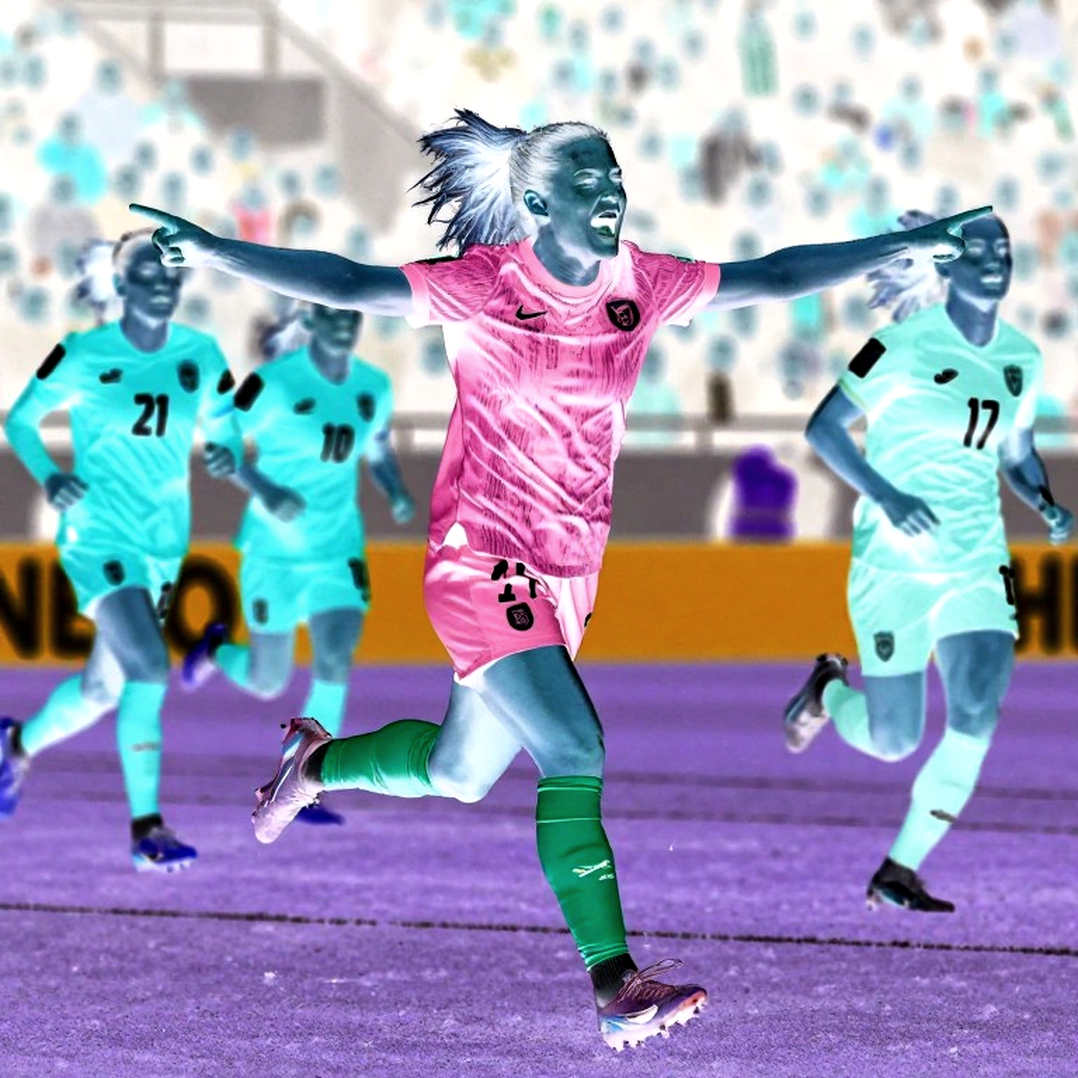
Second goal conceded, 34th minute. A cross from the flank. Minh Quang put the ball into his own net while attempting to clear. I classify this as an individual error inside the box rather than a structural collapse: a defender under physical pressure in front of goal misjudged the flight of the ball. Notably, the source was again a cross into the wide channel.
Third goal conceded, 56th minute. A turnover in midfield. Australia countered and scored. This is the most informative concession, because it arrived early in the second half, after the staff had fifteen minutes to adjust. The mechanism did not change.
Fourth goal conceded, 66th minute. A foul in the box by Minh Hoang led to a penalty. Australia converted to make it 1-4. Adding it up, the four conceded goals fall into two groups: three from turnovers and transitions, one from an individual error in the box. The first group is systemic. The second is situational.
That distinction is not academic. A systemic problem recurs in every match against every opponent capable of transitioning well. An individual error can be fixed through individual coaching and time. If the staff misreads which kind of problem they face, they will fix the wrong thing.
Where the goals came from
Trung Anh's 20th-minute opener came from a corner, with a high jump and a header into the far corner. This is a genuinely positive signal. The dead-ball routine is coached, structured and executed correctly. In Southeast Asian youth football, a team with a proper corner routine often carries a bigger advantage than a team with better individual technique, because set pieces are least affected by physical disparity.
The 71st-minute goal came from a counter-attack, assisted by Trung Anh and finished by Minh Nhat. That pattern is telling: Vietnam U16 scored from a set piece and from a counter, meaning from two situations that do not require imposing a sustained territorial grip.
Read the two goals against the three conceded and a clearer pattern emerges than the scoreline shows. This team attacks most effectively when it does not hold the ball for long, and defends worst immediately after losing it. That is an internal paradox of positive play at an age group still short on physical foundation.
Single-point dependency
Trung Anh scored in the 20th minute and assisted in the 71st. Both Vietnam U16 goals ran through him. Across a single match, that is a praiseworthy individual performance. Across a cycle running to 2027, it is a structural risk.
In youth football, one player standing out above the rest of an age group is normal, even a good sign. The problem is that opponents read it too. In more competitive fixtures, a well-organised back line will man-mark the sole creative source and accept letting others carry the ball. At that point the question is no longer how well Trung Anh plays, but who else can create a chance.
In this match, that answer did not appear. Vietnam U16 scored twice, and both carried the same footprint. A diversified attack needs at least three separate creative sources. That is the work of the next ten months.
The second half and the fitness signal
The 56th and 66th-minute concessions sit in the middle of the second half. The third came from a midfield turnover — exactly the zone where press resistance is most severely tested. When a youth team loses the ball in midfield more often after the break than before it, that usually signals two things at once: physical capacity dropping, and decision-making under pressure dropping with it.
I have no distance-covered or pressing-intensity data to prove this with a model. But the timing pattern is itself a form of evidence, and it is fairly clear: all three transition concessions came after the 25th minute, two of them after the interval. For a team playing three matches in seven days, this is a signal the physical department should log.
At U16 level, a physical gap against opponents with mature school-sport pathways is hard to avoid. Australia was a useful reference: taller, stronger in duels, more comfortable with lofted crosses. That gap cannot be closed inside one tournament, but measuring it is better than not measuring it.
The 83rd minute and game-state management
Back to the penalty. Having gone 1-4 down, Vietnam U16 pulled one back in the 71st minute and kept seeking opportunities until the final minutes. That persistence is a positive signal about mentality and about how well the players are absorbing the staff's instruction. Being awarded a penalty in the 83rd minute at 2-4 is the reward for that persistence.
And in that exact moment, a different gap appeared. Missing a penalty says little about technique, because the sample is one. But a youth team failing to convert a situation that could have narrowed the deficit in the final seven minutes is data about game-state management — the thing that decides a team's fate in a knockout tie.
One small but notable detail: the spot-kick responsibility belonged to Minh Nhat, who had scored earlier. A young player facing such a clearly assigned duty is at least a signal that a hierarchy has been established. The failure to convert in this match is not yet enough to say anything about personnel.
A match without process data — and what that means
This is where I have to be blunt. This match provides no xG, no PPDA, no possession share. Every tactical conclusion in this article is drawn from reading timestamps and described events, not from a quantitative model.
That limits what I can assert. I know three goals came from turnovers. I do not know how many passes Vietnam U16 completed across the three thirds, or what the quality of the chances they created was. Numbers do not lie, but the people reading them do. And in this case, there are no numbers to read.
The consequence is that every commentary on this match, including this one, operates at a descriptive level. Anyone claiming more certainty than description supports is selling you a confidence they do not have.
The contrarian angle: "lessons learned" is an unfalsifiable story
The interpretation arrived quickly: this was a match that delivered necessary experience, the opponent was a quality opponent, and the team produced notable points. That framing is reasonable, consistent with the purpose of a development invitational, and aligned with the cycle aimed at the 2027 AFC U17 finals.
Its problem is not that it is wrong. Its problem is that it is unfalsifiable. A story that cannot be falsified cannot be tested, and what cannot be tested cannot be improved against.
I have worked in this trade long enough to recognise that when an entire defeat is packaged inside the phrase "quality opponent", it is a perfect expectation-management operation. If the result is good, the team overcame a strong opponent. If the result is bad, the defeat was pre-accounted for. Inside that structure, no outcome requires an examination.
What gets left behind is the only thing worth examining: three goals conceded through a single mechanism. That is the blind spot. Nobody counts it, because counting it would force a hard question: if the mechanism repeated three times in ninety minutes against Australia, how many times will it repeat against a continental qualifier with the same transition capacity, in a match where a defeat is not permitted?
The staff's framing is cosmetic work applied to a result, and it is the right thing to do when protecting young players. But at the analytical layer, we have to read the real number. Ghosts do not disappear; they just change shirts. The transition vulnerability inside a build-from-the-back model was not born at this tournament and will not end here. It has simply put on a new shirt, bearing the name of a U16 side.
If forced to choose between a flat 1-0 win and a 2-4 defeat containing three goals from one mechanism, I would still choose the second for a U16 cycle. A defeat teaches more. But it only teaches if someone is willing to read it honestly, rather than wrapping it up and putting it in a drawer.
What happens next
On 27 September 2026, Vietnam U16 face hosts China U16. Three days later, Kyrgyzstan. Those two matches are where every conclusion in this article gets tested, because they supply a mandatory control sample: if the turnover-to-transition mechanism reappears, it is no longer a product of Australia alone.
What I will be watching is not the goal count. I will be watching whether Vietnam U16 adjusts the risk profile of its build-up, whether it rebuilds its rest-defence, and whether it distributes chance creation beyond Trung Anh. Those three questions matter more than whether the team takes points off China.
Seven days, three matches, one cohort built to play a major tournament in 2027. One defeat does not define a cycle. How that defeat is read does.